Unknown's avatar

AB 1010: A Good Bill, If You Can Actually Get It Properly Passed

Good Adjuncts:

In addition to the battle for paid adjunct office hours, part-time equity pay, and more full-time positions, perhaps the greatest concern has been over the issue of job security.

Understand that being an adjunct doesn’t simply mean being part-time, it means being considered an instructor being used, or rather hired, only as needed, with that notion of “needed” being not simply defined by the ups and downs of state budgets, but the whims and personalities of schedulers and administrators, from college presidents to department heads.

This of course is primarily an economic concern for adjuncts, who as a result must live their lives on a three-to-six month basis, even after teaching twenty or more years.  An entire career can collapse in either a quarter or a semester.

Now, to the rare non-teacher who might read this blog, you might be saying to yourself:  “So what? If I have a bad job performance review, or show up to work drunk, or insult my boss, I can get fired, so do I really have job security?”

Well, to be fair, no one does, or should have the kind of job security that allows them to be a crappy worker, and no, unions aren’t about protecting crappy workers. In fact, I get really pissed off when I perceive of an instructor failing to do their job, either because they ignore the needs of students, demean them, or are simply lazy.  They make my job harder.

What unions are about is making sure that you don’t get fired when you are in fact doing your job, or that you don’t get fired off the mere accusation, without substantial proof, that you are doing your job badly.

Even if you’re a non-union worker, I assume that if you were doing your job, and your boss came up to one day, and said, “your fired”, and when you asked why, he/she simply said, “my prerogative,” you would feel it unjust, even if it is legal for him/her to do so.

The thing is, many adjuncts at colleges where there are no-hire rights face the above scenario.  I have heard of adjuncts being told that they would not be rehired because they simply disagreed with or challenged a senior colleagues’ opinion and not necessarily in a confrontational manner or even public forum, but in a private conversation.  Other times, no reason at all will be given.

What maybe adds a little icing on the cake to such injustice is when the adjunct in question may have good evaluations, and seniority over another adjunct who is retained.  Some of these fired (or should I simply say, “left off the schedule”) adjuncts get the pleasure of later learning that their class will be taught be a shiny new adjunct with no previous teaching experience.

In fact, older adjuncts (those north of 50 years of age and 20 years experience) can be a popular target.

Now to be fair, while it may happen on occasion at my own institutions, I must say it is relatively rare (and I know saying this, I’m probably going to hear from people who got screwed, and I should, because when it happens to you, it sure as hell doesn’t feel “rare”) in comparison with some of the horror stories I’ve heard from other colleges.  Part of the reason it is less frequent is because my institutions do have collective bargaining agreements (union contracts) which contain language regarding rehire rights.

That said, there are certain “holes” in the language regarding either the classes you can be re-hired for, the number of classes you can be guaranteed, seniority, etc…

Usually when adjuncts hear this, they are immediately frustrated and angry, and with good reason, but more often than not, rather than blaming the administrators who exploit these holes, or create them through adversarial bargaining, the blame goes on the unions who “don’t care about adjunct issues”.

Now don’t get me wrong, there are many times when unions could and should do more for adjuncts, or at least do a better job of facilitating the expression of their concerns, and I’ve written on this, but often the most contentious discussion that takes place in negotiations, and the place where admin is most intransigent is over adjunct rehire rights.  I’ve seen entire contract negotiations held up over the issue.  Know that wanting something and even expressing it is never a guarantee you’re going to get it, no matter how hard you yell.

This is what brings me to AB 1010. This is a California Assembly Bill that has recently been introduced by Jose Medina, an Assemblyman out of Riverside which calls for the implementation of a union adjunct rehire rights policy for all community colleges.  Read it here:

http://leginfo.ca.gov/pub/15-16/bill/asm/ab_1001-1050/ab_1010_bill_20150226_introduced.html

When I first heard about the bill, I was a bit apprehensive, mainly because I know, from having looked at rehire rights policies in other contracts, that you need to be very careful with the language you have for such policies, because any vague language which is subject to interpretation can be exploited by management, and either overturned or reinterpreted by an arbitrator if the matter reaches the level of a stage three grievance.

This is often why unions and admin will revisit their rehire policies to “clean up” the previous language.

When you pass something as a bill and put it into law, it’s not so easy to do that.  Look no further than the Obamacare case before the Supreme Court being fought over four words in a 600-page document (“established by the state”).

I was also nervous about the potential loss of seniority and rehire rights in the event an adjunct would have to turn down a particular assignment due to extenuating circumstances, like a schedule conflict with another district.  If you read the bill however, you will find that a adjunct will only lose seniority if they turn down ALL classes offered, and to be fair, you’re never going to get a bill passed that would give protections to turn down classes to one’s liking.

Personally, I like the bill as it is written, and I think if it got passed, as it is presently written, that it would be a great windfall for adjuncts in California.

The key here is, as presently written.  I will tell you now, when various administrators see this bill around the state, they will be none too happy with it.

First of all, the bill allows for adjuncts who have received seniority rights (after six semesters), and have received a less than satisfactory evaluation, to be given a written plan for remediation and then re-evaluated in the next semester.  In effect, adjuncts would be given a second chance if they botch an evaluation.  This, in my opinion is a great idea, but I can tell you from having pushed for this in negotiations is something administrators generally hate, and you can be sure they will speak to it.

Another provision in the bill that administrators will be unhappy with is this:

In cases where a reduction in assignment needs to occur due to
program needs, budget constraints, or more contract faculty hires,
the reduction shall occur first from among those part-time, temporary
faculty members who have not yet qualified to be placed on the
seniority list, and thereafter in reverse seniority order, with the
least senior part-time, temporary faculty member reduced first. Any
rights to a certain workload equivalent shall be maintained for a
period of 18 months. In cases of class cancellation due to low
enrollment, faculty members shall displace faculty members who are
lower than they are on the seniority list.

A similar idea was floated by one of the negotiation teams at one of my colleges and it was a complete non-starter.

Now maybe we’ll all get lucky and every administrator and scheduler in the California Community College System will have either had a sudden change of heart, or simply be drunk, asleep, or stoned as the bill winds its way up to the governor, but I wouldn’t bet on it.

Assuming then that we can get this bill past the Assembly and Senate, the next, and biggest hurdle, is…you guessed it, Jerry Brown.  Now Jerry may be down with adjuncts or not, but again, this bill, like the categoricals I mentioned earlier, goes at the heart of the local control issue.  This bill is about effectively taking a part of adjunct hiring policies out of the hands of local districts and putting it in the hands of the state.

Great, I say, and so should you, but again, this gets to what I discussed in my previous entry–there’s going to need to be a change in the philosophy regarding how education is managed in the state.

Do not believe for a minute good adjuncts that I don’t think we should fight this fight-we not only should, we have to.  But we need to know what we’re up against, and we need to be strategizing to achieve this goal.

Part of this should be to wake up our local elected officials to the realities to local control.  Maybe we need to remind them of the city of Bell, and let them know that on a smaller, yet more widespread scale, a similiar misdirection of educational resources and capriciousness of administrators is alive and well.

Anyway, get out there and fight for AB 1010 to be passed, and with real language that works for adjuncts.

Geoff Johnson

A Good Adjunct

Unknown's avatar

The Way Forward: It Gets Complicated

Good Adjuncts:

Now that we’ve acquired a bit of steam from the events of last week, what we do with it and how we make it sustainable is a big concern, and yes, a complicated one.

As a “national” action, NAWD was able to put out some salient points: 1) that adjuncts are treated shabbily, 2) they are an essential, not auxiliary part of academia, and 3) their ill treatment hurts educational institutions, students, and society as a whole.

But see, the thing is it’s easy to point out problems, and far harder to come up with solutions that can be practically achieved.

For the record, as if this needs to be said, what adjuncts need, first and foremost, is full-time employment, and short of that, the same sort of respect in terms of pay, benefits and opportunities as full-time contract teachers with respect to the amount and kind of work they do.

Anyway, the groups I worked with for NAWD concentrated mostly on the categorical allocation of funds for paid adjunct office hours, equity pay, and more full-time positions.  We did this because, 1) the money was there 2) It was something specific 3) it would immediately improve the situation for adjuncts 4) it can be attained easily.

Our situation was also specific to the California state government, which controls our community colleges’ funding, and generally sets labor policy.

We also pursued it because we knew we could get buy-in from a coalition of groups like students, full-time faculty, governing board members and legislators, and even some administrators.

The big challenge here, and the mountain yet before us, is Governor Brown, but more so an outdated philosophy regarding “local” control.  To be brief, this philosophy is that local districts inherently have a better idea of how money should be spent and so therefore the state should effectively pass on the pots of money exercising as little control as possible as to how this money should be spent.  Well, being that this money is largely controlled by local administrators and boards, this has meant that much of this money has gone to places they deem most important, and this has often been at the expense of instruction.

It should be no surprise that administrative services and the money paid to administrators has more or less exploded in relation to the money put towards instruction, nor should it be a surprise that these groups, whether intentionally or no have come to regard adjunct labor as both expendable and exploitable.  As long as administrator’s hands are not categorically forced to deal with instruction properly, school budgets will always be balanced on the backs of adjuncts.

There is of course, two other, more sinister forces at work–political posturing and straight up corruption.

First, in case many of you haven’t figured it out, more often than not, the people who run to be on school boards are not doing simply out of the kindness of their hearts, or because they have a deep commitment to education.  Now by saying this, I’m aware there are true public servants out there and I feel that lately I’ve been working with a few, but let’s be real. Many governing board members are simply filling their resumes for higher office, or are burnishing their public image either for business, or to simply self-aggrandize.  These are people who are often ready to buy into the sound-bite culture of incompetent culture-corrupting teachers, whiny unions, bloated budgets, wasteful spending, etc.  These people see teachers as public servants, and I mean in the Downton Abbey sense of the word servant.

By contrast, they are big on promoting high-profile projects that at times will be more flash than substance, and love creating more and more of those links between the institution and the almighty business community.  This will sometimes lead to things like thousands of dollars being spent on sending a select group of students to a swanky leadership conference while the adjunct office will go for a week or two without a 120 dollar toner cartridge because we (the wasteful adjuncts) need to conserve resources–just put the student handouts up on blackboard, nevermind whether some of your more indigent students can actually afford to download it.

By the way, I’m not anti-business, and community colleges should have such relationships, but I teach World Religions, so you can imagine why I might have a little problem when a curriculum’s worth is evaluated in terms of its strict utilitarian value.

Then of course, there’s the straight up corruption.  Anybody ever notice how local construction companies and certain academic vendors take a very strong interest in local school board elections?  Ever wonder how these groups, many of whom who are fiscally conservative and actually small government, can suddenly get  behind large bond measures?  Did you really think it was because these groups really have a soft spot for the work you do?

I’ll assume that, being as I like to think of my readers as smart, that you would give a big “NO” as an answer to the last question.  One of the latest trends in academia is the building of Wellness Centers on college campuses with the idea that they be open to the general public, and hey, if you can get a private company to run the the site, even better.  Better yet is to charge higher prices than local privately-owned fitness centers operations to boot, then to pitch the whole project as a future revenue stream for the college.

Meanwhile, as for the rotting classroom with rat infestations and lack of adjunct office space?  Well, we all have to make do, you know, and perhaps we can address that in the next bond measure…provided the public will go along with it.

Now bond funds are never used for instruction, but if bond funds are not being directed towards the direct support of instruction, what do you suppose is going to happen to the monies that are with the “stellar” track record up above?

What this all means is that more than just getting a few categorical items in a budget, there has to be a fundamental change in philosophy as to how community colleges and academic institutions are managed, and it needs to come from the top down and with an eye on both transparency and equity.

…And it’s going to take some courage, particularly on the part of the governor of California, to step up and actually starting calling some specific shots and setting priorities rather than waving his hands and telling someone else to do it, or wait for some initiative mandate from the voters, particularly when the initiative process is largely dominated by private big money.

The question California adjuncts and their supporters should be asking themselves now is, how to we get the governor to see what needs to be done?

By the way, there is also talk of a adjunct job security bill as well, and while it faces the same problem of local control, it represents a another can of worms which is perhaps even more complicated and divisive within adjunct ranks.

That will be the subject of my next entry.

Till then, be strong and keep up the good fight good adjuncts.

Geoff Johnson

A Good Adjunct
Unknown's avatar

NAWD Action Item # 10: Wake Up! You’re Still an Adjunct!

Good Adjuncts,

Yeah, I know it doesn’t sound as well the morning after, but now it’s time to drink that bitter cup of coffee, or in my case a 16 oz. can of Rockstar, and get on with it.

First, and I cannot stress this enough NAWD, NADA, or NAAD who whatever you want to call it cannot die.

This is what I’m going to do over the next few days.  I’m going to every site on the blogroll that has a comments page, and I’m telling that henceforth, every fourth Wednesday in February should be declared National Adjunct Day of Action, or well…whatever.

We need to institutionalize this date while it is fresh in mind.

Don’t simply make it the date of 2/25.  Why not?  Because NADA needs to be a day of campus-related action, and needs to take place on campuses, and at times when campus traffic is at its highest–right square in the middle of the week.

We do these actions to empower ourselves and to inform those most directly affect by our presence, exploitation, or again whatever you want to call it–our students.

How many are you going to reach on a Saturday or Sunday rally?  Yeah, you know…

And by the way, we need to do this now, before the various organizations at large get together and tussle with the date, and lose the whole point in their turbidity.

The next thing you need to do, well, I’m going to get into that tomorrow, but now I’ve got Humanities quizzes to grade, because after all, besides being a noise maker and general pain in the ass, I’m a teacher, and yes…

I’m still an Adjunct

Geoff

A Good Adjunct

Unknown's avatar

My Opening Speech at the Southwestern Rally

Let’s hear it for the students here today.

Let’s hear it for the full-time faculty here today.

Let’s hear it for the administrators here today.

Let’s hear it for the governing board members here today.

Let’s hear it for the staff here today.

Let’s hear it for the adjuncts here today.

You know, nothing in my wildest dreams told me 20, 10, or even five years ago that I would be here doing this today.

And I have mixed feelings about it.  Thinking back on my life, I never saw myself as what I have become-an adjunct instructor.  From my early 20’s, I knew I wanted to teach in higher ed., and I knew that above all things I wanted to be a teacher.

I still love being a teacher, and I love even teaching at multiple schools, but I don’t love being an adjunct.

For me at times, being an adjunct has meant waiting desperately each semester for a class assignment, having a car or a Trader Joe’s bag for an office, buying clothes from thrift shops and off Craig’s List, buying food for my kid through the WIC program, or sometimes even having to stand outside a Social Services Clinic cradling my sick child in my arms because I couldn’t afford insurance.

For me, being an adjunct at times means having to tear away from the time I can devote to a student, being bound to somewhere else, where students, often just as needy will also be denied access at times.

Being an adjunct also means being in an ever-growing class of transient instructors, who when the rare full-time position comes open, will join in the competition for the job like wild dogs fighting for table scraps, with perhaps one or two people being lucky enough to win the lottery of full-time job out of up to 230 applicants.

Being an adjunct means standing beside my full-time colleagues, unable to fully take part in tasks like program review, or fully understand department culture, or the big picture, because I am wed to my other campuses, and just as much as the car to which I drive to them.

And being an adjunct has meant making half as much as a full-time colleague of the same experience teaching a 17 hour load while my colleague is only required to do 15.

No, I don’t love being an adjunct, but I’m happy to be here today.

Five years ago, when in the midst of the great recession, and adjuncts were faced with the loss of classes coupled with a 5% pay cut after years of no raises, it wasn’t just that I despaired of being an adjunct, but of the idea that nothing would change.

What I mean by this is that I believed that when economic times got better, and if I survived the recession still employed as teacher, my pay and perhaps some benefits would get slightly better, but that the basic dynamic of living at marginal wages, with marginal job security, and a minimal chance of full-time employment would continue.

Now, maybe it’s not so much that I don’t believe that it could still be the case, but it’s that I’m sick and tired of not speaking out, that I’m happy, especially when I see the opportunity for California to truly begin addressing the “Adjunct Condition”.

This is the “adjunct condition”:

Nationwide, approximately 75 % of college instructors are adjuncts, with only 25% being full-timers.  On many campuses the majority of the curriculum is taught by adjuncts.  Generally these instructors are only paid for classroom hours, not for prepping, grading, researching, professional development, committee work, etc., which often represent anywhere from 60-80% of one’s job.

The “adjunct condition” is also students dealing with a loss of access to their teachers, who will teacher higher than full-time loads at multiple campuses.

Further, it is in some cases, the literal collapse or hollowing out of academic departments, with some departments, while having fully qualified adjuncts more than capable of teaching full-time classes, possessing no full-time faculty.

It is also the ever-revolving door of adjuncts being hired and fired from one place to work at another, which allows for little building of solid departmental goals or consensus.

The “adjunct condition” clearly hurts adjuncts, but it also hurts students.  Student completion rates are declining, and research has established that one of the main causes is the lack of access that students have with their instructors who, as national statistics show, are more often than not adjuncts.

Further, adjuncts are disproportionately used in lower level developing skills and first-year college classes, where often student access to teachers is most needed, yet least provided.

Moreover, the “adjunct condition” hurts the community, as declining completion rates mean fewer trained workers to take jobs that provide growth and advancement, and at the same time, increase a community’s tax base to pay for anything from better parks and schools, to simply better roads.  Second, those students who fail to complete the skills needed for good jobs will often come to need public assistance, or run a higher risk of incarceration, and clearly take more from the community than they are giving back.

If hearing all this makes you angry, then welcome to what an adjunct both feels and understands.

It is the nature of our society to look for villains. Why surely, there must be some clear cause or menace which has perpetrated this wrong.

The fact of the matter is that everyone bears some blame.

Taxpayers for years insisted on lower taxes and stronger law enforcement.  They got what they wanted, or well, sort of—less money for schools and more money for prisons.

Administrators, anxious to offer as many classes as they could, yet keep their budgets in check, increasingly hired adjuncts because they were a lot cheaper and more er. . . flexible.  i.e., easy to get rid of.

Legislators, even when handed electoral mandates like 75% of classes being taught by full-timers, simply chose to, and still choose to waive the law.

Full-timers, often pressed by the own work needs, including the increasing bureaucratic pressures of SLO’s, program review, curriculum development, and various committee work simply tried to keep up with their work.

Adjuncts, willingly accepted to teach classes aware of the poor job security and benefits, most often with the delusion that simply a years of hard work would alone lead them to full-time jobs which either never materialized, or were simply too competitive for all but a lucky few.

But you know what, today is not about anger, or at least not finger-pointing.  It’s about solutions.

In 2012, California passed Proposition 30, which brought needed funds to education, yet despite its passage, much of the debt that California had accrued during the recession had to be addressed, and so in 2013 and 2014, monies to simply save public education were spent.

It is now 2015, the money is there in the budget to affect real change, and change is long overdue.

Change for what you ask?

First let’s give students better access to their teachers.  If after all, schools are all about students, shouldn’t students be better able to access teachers outside the classroom?

It has been estimated that 30 million dollars, not additionally spent, but simply reallocated and specifically targeted to  paid adjunct office hours, could do part of that.

What might better help would be to make pay between adjuncts and full-timers more equal.  This, coupled with office hours will incline adjuncts to work at fewer campuses, and to have the time to not only better consult with students, but to do more thorough prepping, quicker grading turnarounds, and connect better with their campuses.

50 million dollars in adjunct pay parity, again not additionally spent, but simply categorically directed, would bring adjuncts.

Finally, what is most needed, is simply more full-timers.  Many if not most adjuncts, are in fact full-time teachers who cobble together multiple part-time jobs to live tenuously and teach transiently.  If California public really wants to have the best teachers, it should make it possible for the largest numbers of them to singularly devote their energies to one educational institution.

100 million dollars specifically towards the “conversion” (the governor’s office’s own words) of part-time to full-time teachers would change the present part-time to full-time ratio from 75% adjunct and 25% full-time, to 58% Part-time and 42% Full-time.

All told this represents a total of 180 million dollars, not additionally spent, but redirected to meet these needs.

It would be dishonest to say that the categorical allocation of 180 million dollars to address adjunctification would solve adjunctification in and of itself, but it would be a good first step.

There is much to suggest California’s legislature is on board with this, but not Governor Brown, who would rather give it in lump sums to various districts to leave administrators and governing boards to redirect to pretty much everything else but the above three items.

Ironically, Governor Brown is pushing for a high-speed rail project costing tens of billions of dollars, and recently pushed a water bond for billions of dollars.

This is because, as the Governor asserts, he is working towards a long lasting legacy.

What Governor Brown needs to realize is that one’s legacy resides not in physical infrastructure, but in human capital and potential.  One’s legacy resides in the hearts and minds of those that follow you.

The Chinese Philosopher Lao Tzu said that the greatest leaders are those who let the people claim success as their own.  Think of how many future students would be able to speak of their own success if they had increased access to a teacher who is both financially stable and feels respected.

My good adjuncts, and you are good for the work and struggle you have endured, my fellow faculty, administrators, governing board members, and staff, who work with us in the common endeavor to abate ignorance and promote potential, and finally, yet first of all, dear students, we need to make the Governor see what’s right, and we need to do it now, for it will not just affect Governor Brown’s legacy, but the ones that we leave for those who follow.

Unknown's avatar

NAWD Impressions Part II: The Rally at Southwestern

Good Adjuncts,

The rally at Southwestern was by any measure a resounding success.  We had hundreds of attendees, and over an hour into the rally (we ended up going over by more than a half hour), there were still over 100 people in attendance (and I don’t mean walk bys).  We signed so many letters (200+), that we actually ran out.

What was perhaps the most astonishing and moving thing was the parade of adjunct after adjunct who spoke so powerfully about their situation, their love of teaching, and the wrongs of adjunctification.  Notably, the tone was consistently positive.

It was the largest rally that Southwestern has seen in memory.

As I told the attendees when I closed the rally, “This rally is only the first page in a very long novel about social justice which will hopefully have a happy ending.  It is now upon all of us to be good authors.”

Geoff Johnson

A Good Adjunct

Unknown's avatar

NAWD: (National Adjunct Whatever Day) Where the Action is in San Diego County

Good Adjuncts,

Look these rallies today, and when and where they are located:

Community Colleges

12:00-1:00 at City College in Gorton Quad

12:00-1:00 at Mesa College outside the LRC

12:00-1:00 at Palomar College

12:30-1:30 at Southwestern College on the Mayan Theater Patio

2:00-3:00 at Grossmont College outside the LTRC

4:00-6:15 there will be an Adjunct Appreciation Party at Miramar College in room K-107.    Pizza and refreshments will be served.

Four-Year Institutions

11:30 UCSD will have a student walkout, followed by a teach-in round table discussion from

12:30 at the Yosemite Room

Act up!

Geoff Johnson

A Good adjunct

Unknown's avatar

NAWD Action Item #9: Act Up So That Others No Longer Live and Work in Fear

Good Adjuncts:

We are 24 hours away from the largest labor action in Adjunct history, and we need to act up.

This past weekend, I went to a statewide teacher’s union conference.  Knowing that many of the adjunct reps in the union, especially the statewide reps, were highly supportive of efforts of adjuncts to improve their own lot,  I went to the conference with the positive hopes that I would be networking on actions that we going to happen, and I expected some discussion of the matter by the state leadership.

Instead, in the words of George Castanza, I got nothing.

On the part-time literature table, I saw nothing but the same generic union crap that always gets passed out, except that this time there wasn’t even anything about equity.  It was in fact worse than when I went to the conference in the Fall.  One of the people there, a person who was in fact organizing an NAWD march on Sacramento, didn’t even have stickers to promote his event.  I had to give him stickers.

Later, in a special session on part-time organizing, the organizers deftly managed through their presentation to talk about everything but Feb. 25th.

I, being the kind of guy I am (and if you haven’t that figured out, you’ve never read me before) made it clear they were not dealing with the issue.

To my comments, I was told the idea of NAWD was broached, but that the leadership was afraid that it would cost workers their jobs, and so they did nothing.

Well yes, if people just up and walked off the job, that would be a fear, but why didn’t any of these brainiacs think of calling it simply a “Day of Action”, and organize rallies or symbolic “walkouts”?

The complete lack of creativity here is astounding.

Just so you know, six of the eight major community college campuses in San Diego County are having rallies.

And why, when others do nothing?  Because we’ve thought it out, formed links with student governments, academic senates, full-time faculty, governing board members, and even administration.

…And because, those of us who refuse to live in fear must act because others quite apparently do, and unless we act, they will continue to do so.

By the way, as I and my comrade in arms, John Hoskins, have shown in the action items, there’s a lot you can do without baiting the bear, if you really think the bear’s going to eat you.  Do the following if at all possible:

1)  Wear stickers which identify you as an adjunct, and make it clear that you’re essential.

2) Get students to wear stickers.

3) Get your full-time faculty, administrators, and governing board colleagues to wear stickers in support (I have gotten more help from these groups than even from my own adjuncts to see this event happen).

4)  Send letters to your governor, board members, and state legislators calling for specific changes, like paid office hours, equity pay, more full-time positions, etc.

5) Show up at rallies.  If you’re afraid to be at a rally at your own campus, go to another campus’s rally.

And stop being afraid!

Geoff Johnson

A “Good” adjunct who refuses to live in fear.

Unknown's avatar

NAWD Action Item #8: Write a Politician a Letter

Good Adjuncts:

Having a rally and making noise is good, turning it into action is better.  In California currently many activists are engaged in getting the Governor to address adjunctification by categorically dedicating:

30 Million dollars to adjunct office hours

50 million dollars to equity pay

100 million dollars to more full-time positions

In addition, there is proposed legislation being considered regarding the creation of three-year contracts for adjuncts.

Anyway, below please notice series of sample letters you might send to Governor Brown.  Copy and paste one into a word file, sign it and send it to one of the addresses given below:

Governor Jerry Brown

c/o State Capitol, Suite 1173

Sacramento, CA 95814

Dear Governor Brown:

As you may or may not know, part-time, temporary instructors teach approximately 70% of the courses at community colleges. In many districts these individuals are paid far less than their full-time counterparts even though they have exactly the same credentials and teach exactly the same courses.

As a result, many of these part-timers are forced to take on multiple jobs and work in multiple districts in order to make ends meet. Furthermore, very few districts compensate adjunct faculty for office hours and those that do often compensate at a very low rate (in some cases barely more than the minimum wage).

Given that there is a clear benefit to students from faculty who are decently compensated, and given that students benefit greatly from access to faculty during office hours I would encourage you to increase funding in the state budget in order to correct these deficiencies.

Specifically, I am asking that you allocate additional funds for the categorical line items that currently exist for parity/equity compensation and paid office hours for part-time temporary faculty in the California Community College system in the amount of $30 million for paid office hours, and $50 million for parity/equity compensation. In addition, I ask you to also allocate $100 million for the conversion of existing part-time temporary faculty to full-time faculty status.

Sincerely,

­____________________________

(sign)

____________________________

(print)

____________________________

(date)

Here’s Another:

Governor Jerry Brown

c/o State Capitol, Suite 1173

Sacramento, CA 95814

Dear Governor Brown:

As a part-time faculty member teaching in a California community college, I am writing to ask your support in improving the quality of higher education in our state by bettering the working conditions experienced by part-time instructors who teach 70 – 80% of all college classes today. Although part-time faculty are highly trained professionals who hold the same qualifications and deliver the same instructional services as our full-time counterparts, we receive only 50 – 60% of the financial compensation earned by full-time faculty on a per class basis.  We find this inherently unfair – to our students, to our institutions, to the taxpayers at large, and to ourselves.

Over the last six years, the number of students either earning a two-year degree at a California community college, or transferring to a four-year institution, has fallen by 2.6%. Studies at the Cornell Higher Education Research Institute show this is a direct result of the inequalities that currently exist between part-time and full-time instructors. Because part-time faculty receive lower pay and few if any benefits, many of us are compelled to take on teaching loads which exceed those of our full-time colleagues. We work at multiple institutions of higher learning, which reduces our availability to students as well as the time we can devote to providing vital feedback on student work and to preparing for classroom instruction. This negatively impacts student retention and graduation rates.

Our institutions of higher learning and the taxpayers at large are adversely impacted as well. Many of us live under financial duress. Some of us, after years or decades of dedicated service to the profession we love, find the hardship too great, and leave teaching altogether.  Our students and our institutions feel such losses keenly, as do we ourselves. Those of us who persist in our educational calling are often compelled to draw regularly on state unemployment or food stamps in an effort to survive between, and even during, semesters.  News media have also reported dramatic – but telltale – stories of tragic homelessness for some part-time educators. We do not wish to rely upon social services to make ends meet, but part-time/full-time inequality has created a paradoxical situation in which some of our society’s most highly educated and productive citizens come, by necessity, to rely upon welfare programs paid for by taxpayers.

Specifically, I am asking that you allocate additional funds for the categorical line items that currently exist for parity/equity compensation and paid office hours for part-time temporary faculty in the California Community College system in the amount of $30 million for paid office hours, and $50 million for parity/equity compensation. In addition, I ask you to also allocate $100 million for the conversion of existing part-time temporary faculty to full-time faculty status. Help us to create fair and equitable working conditions that will benefit our students, our institutions, and our taxpayers by building today the basis for an educated tomorrow.

Sincerely,

­____________________________

(sign)

____________________________

(print)

____________________________

(date)

Governor Jerry Brown

c/o State Capitol, Suite 1173

Sacramento, CA 95814

Dear Governor Brown:

Let me begin by acknowledging that, given your recent budget proposal, it is clear that you value the California Community College System, and recognize its importance for the citizens and the future of our great state. That being said, I am writing to ask you to more clearly set aside some of the money in your proposed budget specifically for adjunct issues. As I hope you are aware, adjuncts make significantly less than their full-time counterparts despite teaching the same courses with the same credentials and the same level of experience. Furthermore, these part-time professors must work multiple jobs at multiple districts to make ends meet. This all too often comes at the expense of students because their professors simply don’t have enough time in the day to give these students the time they need in order to be successful. The only way to address this problem is to reduce the number of adjuncts and improve the working conditions of those that remain.

While I understand that you prefer to leave a great deal of control over budgeting to local districts, the simple fact is that this kind of attitude has only made the situation worse. In those districts with strong unions, various protections have been established for adjuncts, but these tend to be the exception rather than the rule. If we want our students to succeed, if we want to retain them and ensure their ability to graduate or transfer and succeed at four years colleges, we must do more to improve the lives of the adjunct instructors who are increasingly the backbone of the community college system.

Consequently, I am asking you not to increase your already generous budget for the community colleges, but instead to take some of the money out of the budget an earmark it for adjunct concerns. Specifically, I am asking that you allocate additional funds for the categorical line items that currently exist for parity/equity compensation and paid office hours for part-time temporary faculty in the California Community College system in the amount of $30 million for paid office hours, and $50 million for parity/equity compensation. In addition, I ask you to also allocate $100 million for the conversion of existing part-time temporary faculty to full-time faculty status.

Sincerely,

­____________________________

(sign)

____________________________

(print)

____________________________

(date)

Addresses for National Adjunct Action Day Lobbying Campaign All letter should be addressed to the Governor and then CC the other people on the list.

Governor Jerry Brown State Capitol, Suit 1173 Sacramento, CA 95814

Speaker of the Assembly Toni Atkins P.O. Box 942849 Sacramento, CA 94249-0078

Senate President Pro Temp Kevin De León

State Capitol, Room 205

Sacramento, CA 95814

Senate Education Budget Subcommittee Chair Marty Block

State Capitol, Room 4072 Sacramento, CA 95814

Assembly Education Finance Budget Subcommittee Chair Kevin McCarty

P.O. Box 942849, Room 2160

Sacramento, CA 94249-0007

Department of Finance Director Michael Cohen

915 L Street

Sacramento, CA 95814

Department of Finance Program Budget Director Nick Schweizer

915 L Street

Sacramento, CA 95814

Community College Chancellor Brice Harris

1102 Q Street, Suite 4554

Sacramento, CA 95811

Now start writing and sending those letters good Adjuncts!

Geoff Johnson

A Good Adjunct

Unknown's avatar

NAWD Action Item #7: Make and Wear a T-shirt

Good Adjuncts:

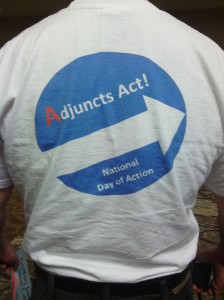
For those of you who like something more visual and durable (It’s not like after Feb. 25th the skies will cleave open and adjuntification will disappear and birds will sing),  a T-shirt may be the better way to go.  I know there are a few designs already out there, but this is one that we came up with at Adjunct Crisis.

t-shirt 1t-shirt 2

If you want, I can send the jpegs of the designs so you can make one for yourselves.  For any San Diego Mesa College or Southwestern Community College folks who want a shirt, I’ll be contacting you via campus email.

Geoff Johnson

A Good and Sartorially Splendorous Adjunct

Unknown's avatar

NAWD Action Item #5: Write Number(s) on the Board Which Show Adjunct Reality

Good Adjuncts:

If either any of the other adjunct action items haven’t suited your fancy, or if you want to try a different tack with your students, it’s often the case that numbers speak louder than words.

So here’s what you might do…

At the beginning of the class, and right in the middle of the board write a number.  Say nothing.  As you continue to teach and use the board, work around the number, but leave the number in the center of the board.

After a while, or in some cases, immediately, a curious student will likely as the significance of the number you put on the board, and of course you will then need to explain it to him or her, and if done right, this id going to generate discussion.

If this doesn’t work, you can simply lead students into a “guess the meaning of the number” game.

Here are some numbers I like to throw out:

53% or 58%:

The amount I am paid proportional to a full-timer, depending on district, for the same teaching hour.

4

The number of times I have been on employment in the last two years.

41,731.80

My Last year’s salary

84,205.00

What I would have made as a Full-timer with the equivalent years of teaching and education

17

The number of units I teach at the above salary

15

The number of units a full-timer teaches for the higher salary listed above

55-60

The number of actual hours I work during a teaching session

3

The number of consecutive days I went without seeing my then young son awake in spite of living in the same house due to my work schedule

1

Times my wife, near having a nervous breakdown, threatened to leave me because of my work schedule

286, 000

The number of miles I had on my 1984 Mazda Sundowner Pickup before I got rid of it last year.

4

The number of times I was unable to make it to class in a five-year period due to car trouble with said car.

146,000

The number of miles on my “new” car when I got it.

21

My true average hourly wage after earning an MA +30 units, graduating with honors, and 26 years of teaching experience, with 15 of which being specifically in Higher Ed.

20

The number of extra unpaid tutoring hours I provided to at-risk students for my composition class.

8

The number of students who would not have passed without the extra tutoring

Give ‘em the numbers good adjuncts, make ‘em know.

Geoff Johnson

A Good Adjunct