Unknown's avatar

A Sestina For the Educated Tool: An Adjunct Poem

Sestina for the Educated Tool

Assuming ethos before my students,
I argue education’s importance
as a vehicle to one’s lifetime goals:
“Knowledge is a tool for empowerment
which can raise one out of poverty
and evoke a world of possibilities.”

Yet there are other possibilities,
ones that teachers rarely tell their students:
That education won’t prevent poverty
as long as efficiency’s importance
affects those who seek some empowerment
outside the margins of spreadsheeted goals.

Within the margins of spreadsheeted goals
exist only funded possibilities
meant to equate educational empowerment
with credentialing workers. Those students
looking beyond economic importance
find riches rewarded with poverty.

Yes, these educated toil in poverty
caused not by lack of professional goals
but rather, by the deferred importance
of human values and possibilities
not tied to direct paychecks for students,
but about personal empowerment.

My ethos, you see lacks the empowerment
of a promised escape from poverty.
Truly, were I honest with my students
I should reveal to how sometimes, the goals
of others deny possibilities
which are reflective of our own importance.

In fact, it is their presumed importance
which makes education without empowerment,
and instead makes possibilities
fade before the working poverty
of educated tools, whose unreached goals
are projected onto ideal students.

Possibilities beyond poverty
ensure importance and empowerment
when goals empower teachers and students.

Unknown's avatar

A Little Screen Saver Art

boom2

Unknown's avatar

“A New Day in Otay”: An Adjunct Poem

New Day in Otay

It’s 6:45 and I’m driving up the 905
A can of Rockstar in my hand, trying to revive
Up till one marking through a set
Of essays comparing Frederick Douglass to Malcolm X
Struggling to read, and my students too
have challenges in prose, most tortured attempts
of grammar and syntax, their sentences often
show a dream deferred of how their parents
crossed a border now just minutes away in space
and yet how after 40 years of “progess”
there’s still another border to be crossed.
I teach to help my students climb the fence
That lies between Walmart, the prison,
public assistance and the dream
which takes commitment, and yet,
Spurred by a border of my own, asserting I
Can never call any one college my own, must
Leave these dreams deferred as the sun now is high
And its pounding heat leaves the land dry.

Note:  Otay here refers to the Southwestern College Higher Ed. Center in Otay Mesa, located on a relatively barren patch of land just two miles from the U.S./Mexican border and three miles from a medium-security prison.

Unknown's avatar

Inequality for All in America’s Higher Education System

Originally published on the San Diego Free Press:

By Jim Miller with Ian Duckles

Last week I had the pleasure of seeing Thomas Piketty speak on economic inequality at UCSD. In his talk, Piketty hit on the central themes of his seminal work, Capital in the Twenty-First Century: how our current level of economic inequality is now back to where it was before the “great compression” of the mid-twentieth century when union density, progressive taxation, and educational policies helped produce the high point of the American middle class. He underlined how there is no economic benefit to our current level of excessive inequality and that it is the product not of any “natural” function of the free market economy, but rather several decades of wrong-headed ideology, destructive politics, and bad policy. During the question and answer session following his presentation, a well-heeled older gentleman prefaced his question about why the “lower 50 percent” don’t just vote out the bad policies with, “this audience, we’re all the top 10%,” which drew a few laughs from people, many of whom were likely debt-ridden students, teaching assistants, campus workers, and lecturers whose income doesn’t come close to landing them in that realm. That there may have been a ragtag group of professors and students from lowly City College in attendance was not even in the speaker’s imagination. I couldn’t help but think how UCSD is a perfect microcosm of the macroeconomic inequality that Piketty was talking about and that the class-blind commenter was a perfect manifestation of the very elite ideology that serves to enforce our deep level of inequality. But of course, it’s not just at UCSD where this is an issue but across the entire landscape of American higher education, where what used to be one of the most solid middle-class professions in the country is in the process of being hollowed out, bit by bit. Coincidentally, October 26th through the 29th happens to be Campus Equity Week, a twice-a-year action designed to bring attention to this very problem. Thus, I will leave the rest of my column to Dr. Ian Duckles, my adjunct colleague in the San Diego Community College District, to further illuminate this issue.

Why Campus Equity Week? Monday is the first day of Campus Equity Week 2015, a biannual event first held around the turn of the millennium to draw attention to and raise awareness about issues confronting what are variously known as “adjuncts,” “contingent faculty” or “part-timers.” Defined in the California Educational Code as “part-time, temporary faculty,” adjuncts were originally intended to be just that: supplements to the full-time faculty to teach classes that wouldn’t support a full-time hire, or to help fill out a schedule and cover for sabbaticals and leaves. If, for example, a college wanted to offer courses in real estate, they wouldn’t necessarily hire a realtor full-time (who probably wouldn’t want to take the pay cut to become a full-time instructor), but instead invite a realtor to teach a class or two per semester. In this way, the college could take advantage of the professional expertise of these individuals without forcing them to quit their day jobs, the very thing that qualifies them to teach in the first place. There is clearly a role for this kind of instructor in the community colleges and schools wouldn’t be able to offer such a diverse list of courses and certificates without the assistance of these kinds of professional, part-time instructors. Unfortunately, the role of these “part-time, temporary faculty” has shifted considerably over the last 40-50 years. During the late 60’s to early 70’s the ratio of adjuncts to full-timers was about 20% to 80%. Today, the numbers have almost completely reversed with adjuncts making up about 75% of the faculty and full-timers making up about 25%. This shift in the make-up of higher education faculty is mirrored in all areas of higher education (community colleges, Cal States, UC’s and even many private colleges), and has some significant, negative impacts. In what follows, I want to explore these negative impacts on the adjuncts themselves, students, and full-timers. Beginning with the adjuncts, this emphasis on hiring part-time faculty has significant, negative consequences for those teaching professionals. These consequences are numerous and wide-ranging, but I will highlight just a few. In addition, because there are so many adjuncts, and these adjuncts live such a diversity of lives, it is difficult to speak for everyone. Instead, I will focus on my personal situation as a window into the broader issues confronting part-time college instructors. Perhaps the most significant impact is that even though I have a Ph.D. and over 10 years of teaching experience, I make significantly less than my full-time counterparts for the same work. As a quick example, I interviewed for but did not get a position at Miramar College back in 2008. Had I been hired, today I would be making an annual salary of $80,000-$90,000 for

Source: Inequality for All in America’s Higher Education System

Unknown's avatar

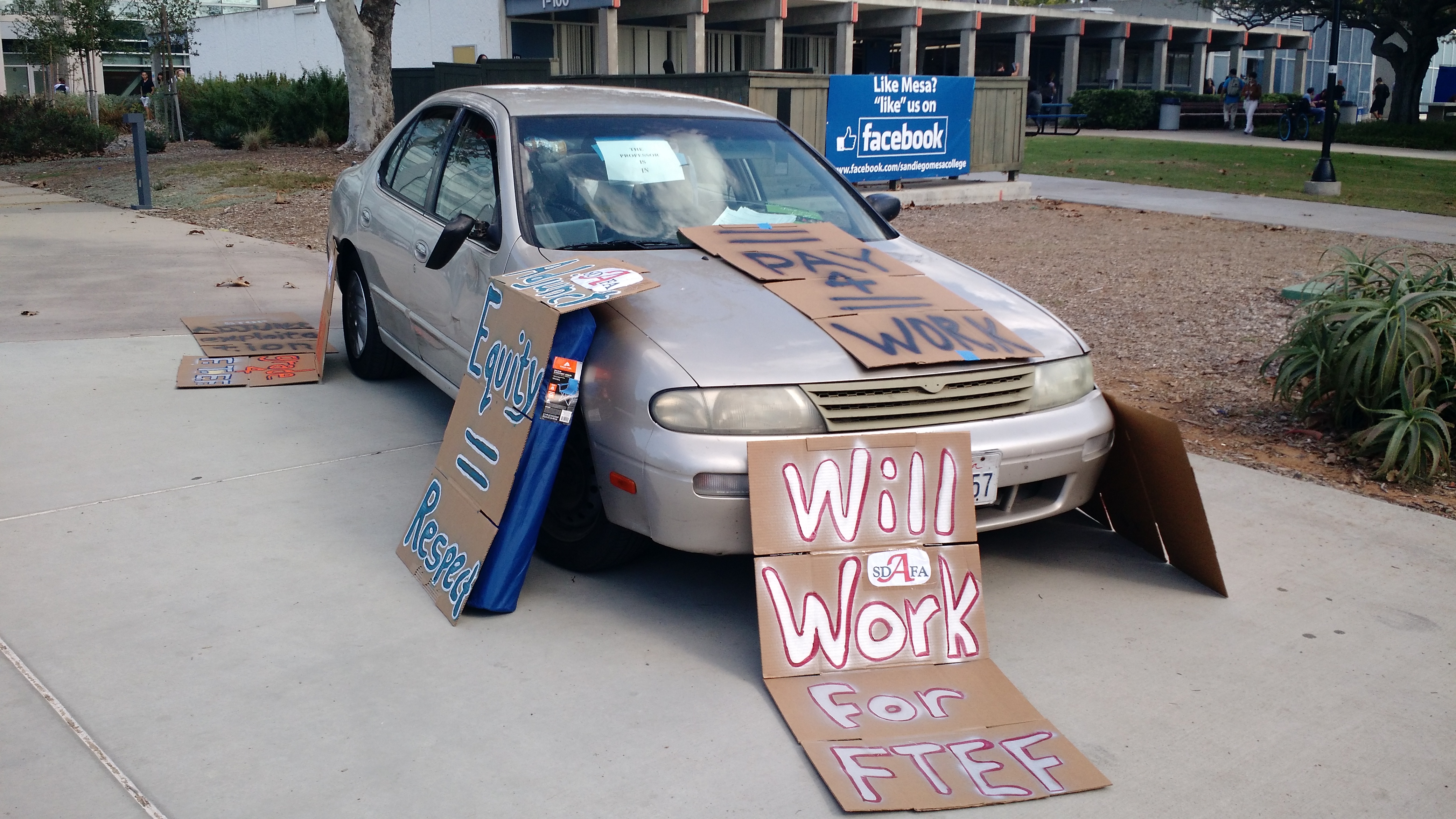
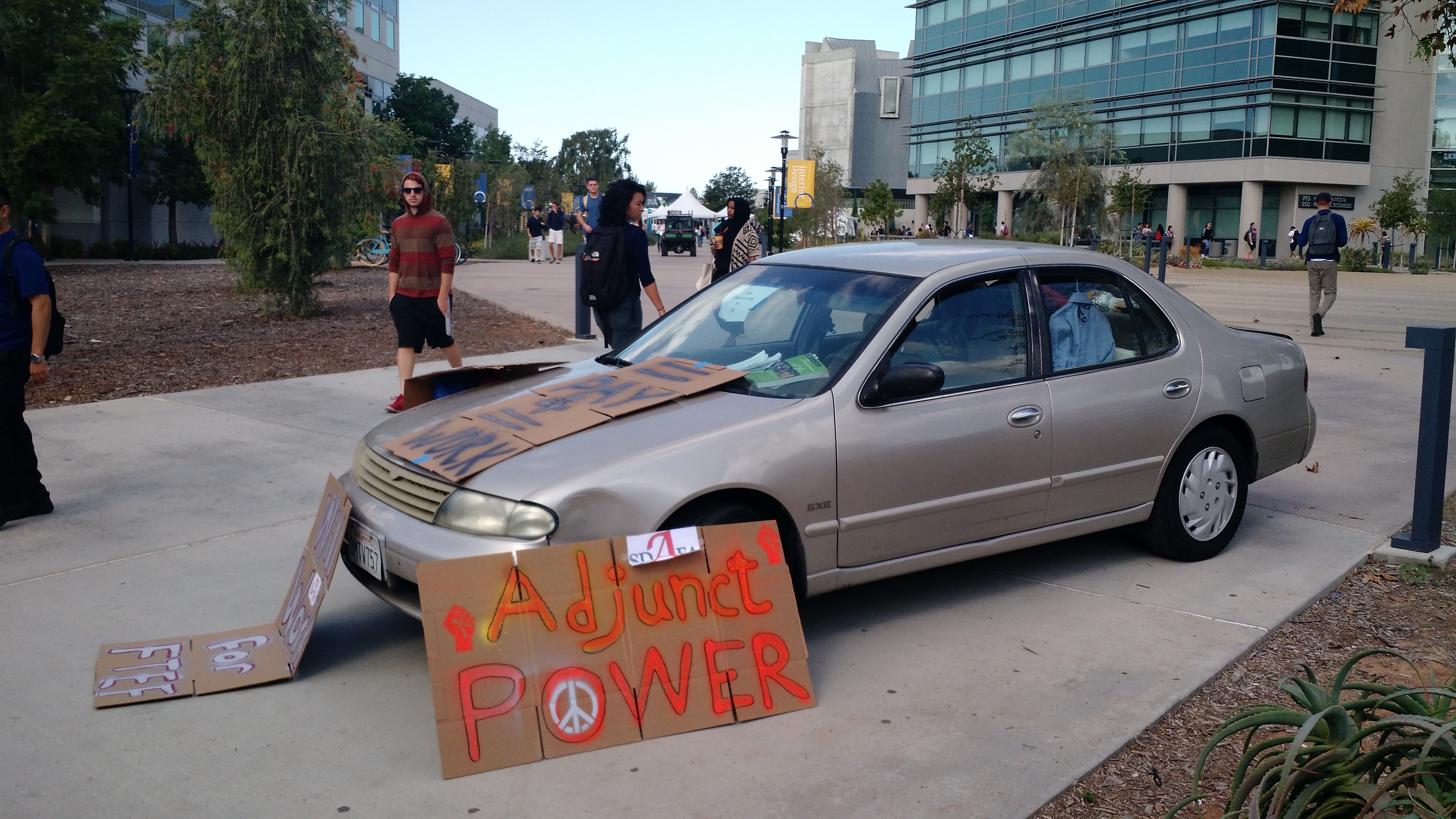
Freeway Flyer Office: Mesa College Campus Equity Week 2015

IMG_20151029_110255063The classic adjunct office.

IMG_20151029_110312478

Unknown's avatar

Campus Equity Week 2015 at San Diego Mesa College

Here is the schedule for Campus Equity Week 2015 events at Mesa College:

Campus Equity Week Mesa Schedule 2015

Unknown's avatar

Equity Week promotes truth about adjuncts

More from Shane O’Connell at The Mesa Press:http://www.mesapress.com/news/2015/10/22/equity-week-promotes-truth-about-adjuncts/

Unknown's avatar

Myths about College Degrees and the Job Economy

This blog post, by Bob Samuels, from the blog “Changing Universities,” not only concisely ties the link between income inequality and higher ed., but  identifies what every adjunct ultimately learns and what every student needs to be taught as regards the value of a college education:

Of course, the wealthy have used their financial advantages to not only game higher education but also the political system, which helps to enhance wealth through tax policies and anti-labor practices. Yet, even with all of the ample evidence that most of the wealth and wage inequality is being driven by corporate hording and governmental policies favoring the super-rich, Cassidy continues to argue that we really do not know what is going on: “Why is this happening? The short answer is that nobody knows for sure. One theory is that corporate cost-cutting, having thinned the ranks of workers on the factory floor and in routine office jobs, is now targeting supervisors, managers, and other highly educated people. Another theory is that technological progress, after favoring highly educated workers for a long time, is now turning on them.” Here we see how the focus on technology and education blinds us from seeing how human greed is driving the exploitation of labor, and without any counter-force, like strong unions, governmental regulations, and progressive tax policies, there is nothing to stop the concentration of wealth at the top. 

Instead of hoping that higher education should be the solution to all of our economic problems, we should follow Cassidy’s advice and return to the notion that college is a public good and an end in itself: “Being more realistic about the role that college degrees play would help families and politicians make better choices. It could also help us appreciate the actual merits of a traditional broad-based education, often called a liberal-arts education, rather than trying to reduce everything to an economic cost-benefit analysis.” If we focus on making higher education more accessible and affordable as we enhance its quality, we can at least make sure that it does not enhance inequality and decrease social mobility. The first step is to stop believing that college degrees produce good jobs.

Unknown's avatar

The Mesa Press Covers Campus Equity Week 2015

Student journalist Shane O’Connell, writing for The Mesa Press, covers Campus Equity Week: “Campus Equity Week Aims to Open Discussion Over Adjuncts”

O’Connell’s excellent report represents the most comprehensive coverage of the adjunctification at Mesa yet. Look for his continued coverage in The Mesa Press

Unknown's avatar

Time for the Professoriate to Lead the Way

I haven’t reblogged anything for quite some time, but this piece is timely and resonates with most of what I have written about the need for tenured faculty to recognize that higher education is near death and the crisis we face is an adjunct crisis because tenured faculty are becoming adjuncts. It is happening not because there isn’t enough funding but because tenured faculty, and adjunct faculty (the greatest number of whom suffer from some kind of complacency, even if it is just that they don’t have the time), are not resisting forcefully enough, a condition which has been ongoing for decades. Will we rise up, achieve true solidarity (beginning with equal pay for adjuncts), and muster the power of the full professoriate, tenured and adjunct?
Pancoast makes a number of cogent points here:

aiotb's avatarThe As It Ought to Be Archive

adjunct_prof

Time for the Professoriate to Lead the Way

by William Trent Pancoast

It’s about time for working folks to stand up for themselves. Walmart workers haven’t been able to get it done. The old line unions are still reeling from the ongoing attacks begun by Reagan and continued by the right wing.

It looks to me like it should happen on our college campuses, and it should for starters be about adjunct instructors having a chance to make a living wage with benefits. That will require that tenured faculty support adjuncts. Much of the bargaining success of the United Auto Workers resulted from skilled and unskilled (high wage and low wage) belonging to the same union. Tenured faculty, making $50,000-$175,000 annual pay with health care and retirement, and adjuncts, making piecework of roughly $400 to $1000 per credit hour taught with no benefits, must join together. They need to form…

View original post 967 more words